
Reading time: about 4 minutes · Cover: AI-generated illustration.
My portfolio was worth ₹5,86,74,034.64 on 25 November 2026. If that amount had gone into Nippon India Small Cap Fund ten years earlier, it would have grown to about ₹39.68 crore in this historical backtest. My Short asked what monthly SIP would reach the same figure. Using the latest dated portfolio snapshot, the answer is about ₹10.79 lakh a month. The comparison changes when both routes have the same total budget.
I’m Ankit Khare. I publish dated updates on my investing journey and explain mutual funds with examples. My published portfolio value sets the starting amount here; I did not invest that entire sum in this fund as part of this example.
The starting amount
My published 25 November portfolio shows ₹4,96,25,364.88 invested and a current value of ₹5,86,74,034.64. The app shows a total gain of ₹90,48,669.76 (+18.23%), which is not an annual return or XIRR. I use only the snapshot’s current value as the starting amount in a separate hypothetical comparison. The ₹39.68 crore below is not my actual portfolio value.
The SIP that matched it
Both routes use the same fund, plan and final NAV. The lump sum invests ₹5.87 crore on day one; the SIP spreads contributions over 120 months. A ₹10 lakh monthly SIP ended at ₹36.76 crore, while ₹11 lakh reached ₹40.44 crore. The amount that matches the lump sum is about ₹10,79,325 a month. Over 120 months it would require contributions of about ₹12.95 crore.
| Route | Total contributions | Value on 25 Nov 2026 |
|---|---|---|
| Lump sum on 25 Nov 2016 | ₹5.87 crore | ₹39.68 crore |
| SIP: same budget (₹4.89 lakh/month) | ₹5.87 crore | ₹17.97 crore |
| SIP: same final value (₹10.79 lakh/month) | ₹12.95 crore | ₹39.68 crore |
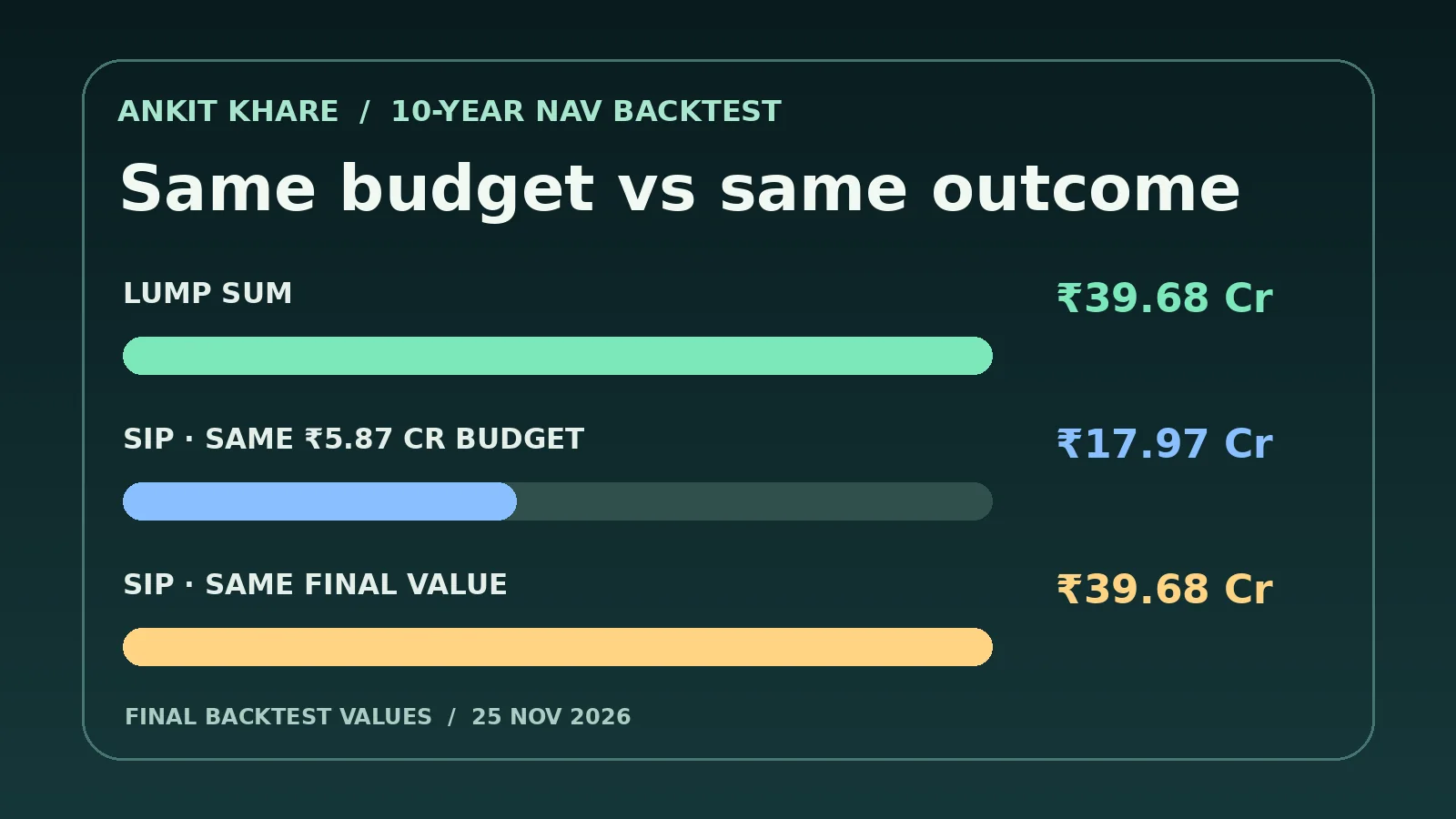
Comparing the same budget
If the budget is fixed at ₹5.87 crore for either route, divide the exact amount by 120. The monthly SIP is ₹4,88,950.29, and the final fund value is ₹17.97 crore. The routes give different amounts of time in the market to different portions of the money. The same-budget example does not credit interest on cash waiting for future instalments.
For a smaller example with the same NAVs and dates, ₹5 lakh invested upfront reached about ₹33.81 lakh. Spread that same budget into roughly ₹4,166.67 a month and the SIP reached about ₹15.32 lakh. Both are results for this period, not forecasts.
How the backtest works
Nippon India Small Cap Fund Direct Plan–Growth (AMFI 118778). NAV was ₹29.8868 on 25 November 2016 and ₹202.0944 on 25 November 2026. The first SIP was on 25 November 2016. There were 120 instalments, scheduled for the 25th of each month and moved to the next available NAV date when necessary. The last instalment used the 26 October 2026 NAV. Lump-sum units equal the amount divided by the first NAV; SIP units are the sum of each instalment divided by its applicable NAV. Multiply units by the final NAV for terminal value. Units are not rounded mid-calculation. Stamp duty, taxes, exit load and interest on uninvested cash are excluded.
What the result means
The Short used 9 November 2016 to 9 November 2026. I moved both ends of the ten-year window to 25 November and updated the starting balance, so this is not a simple rescaling of the original result. Getting the whole sum invested early helped in this window; a steep early fall can change how the comparison plays out. And if the money comes from future paychecks, it was not available on day one. The scheme is rated Very High risk. This example is educational, not a recommendation.
Sources
- 25 Nov 2026 · Ankit Khare portfolio snapshot
- YouTube Short · SIP या एकमुश्त: कौन आगे?
- AMFI NAV history · scheme 118778 data series (MFapi mirror)
- Nippon India Mutual Fund · scheme note and riskometer


चर्चा / Comments