
Reading time: about 3 minutes · Featured image: AI-made illustration, not NAV data.
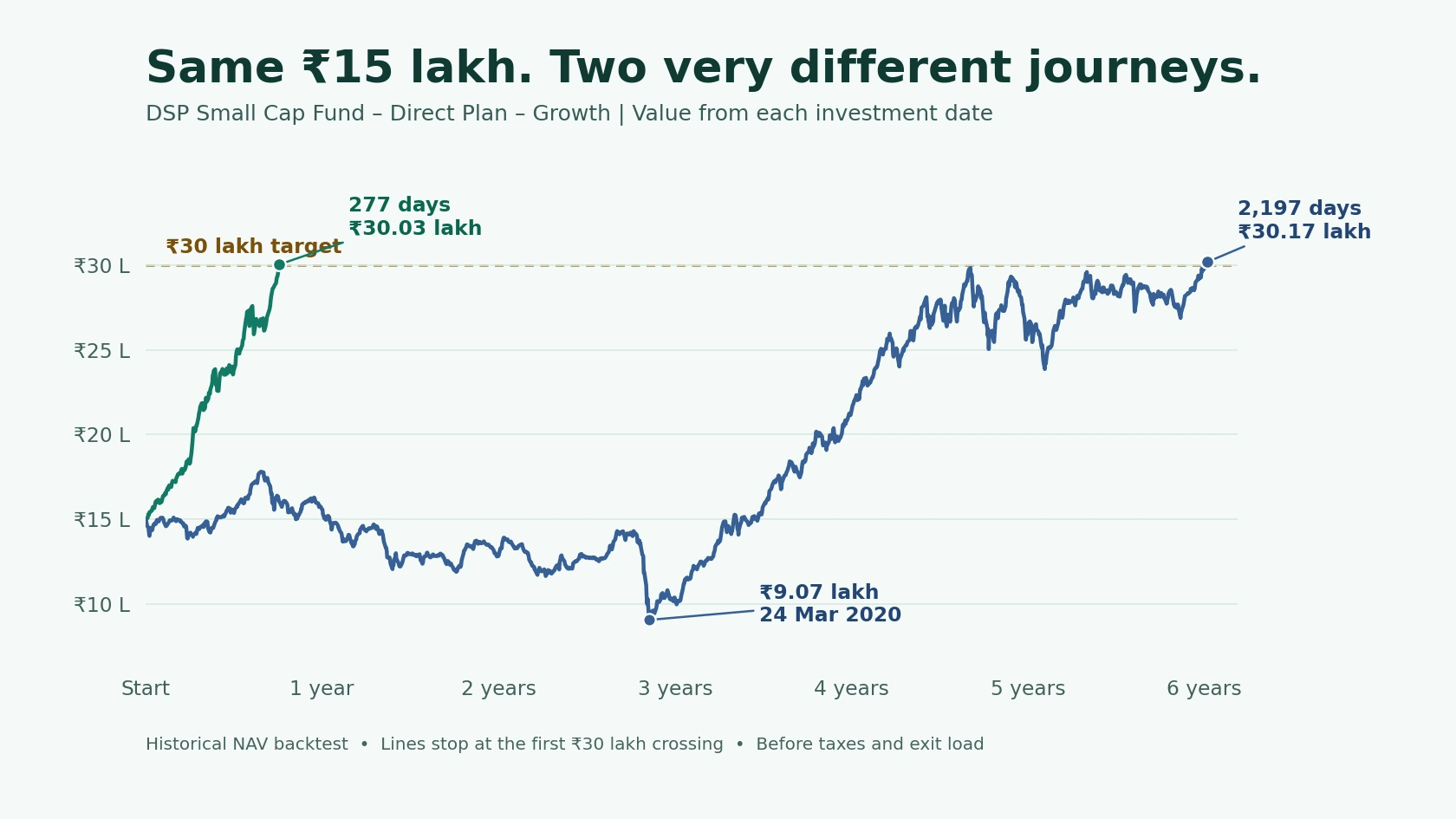
Same fund, ₹15 lakh invested each time. One February 2014 start first crossed ₹30 lakh in 277 days. A May 2017 start needed 2,197 days, and the investment was worth about ₹9.07 lakh along the way. The choice of fund was the same; the entry date was not.
An important distinction: the May 2017 start is a hypothetical NAV path. A fresh ₹15 lakh lump sum could not actually have been invested in the fund on that date.
The fast and slow starts
Two starts in DSP Small Cap Fund Direct Growth tied for the fastest observed doubling: 13 and 14 February 2014, both at 277 days. The table uses the earlier start and the slowest start that actually reached the target before the data ended. Neither extreme predicts a future timeline.
| Start | First doubled | Days | Entry → first hit NAV | ₹15 lakh value |
|---|---|---|---|---|
| 13 Feb 2014 | 17 Nov 2014 | 277 | ₹17.979 → ₹35.994 | ₹30,03,004 |
| 16 May 2017 | 22 May 2023 | 2,197 | ₹63.872 → ₹128.483 | ₹30,17,355 |
DSP (then DSP BlackRock Micro Cap Fund) suspended fresh lump sums from 20 February 2017 and reopened on 1 April 2020. The 16 May 2017 row is not a transaction record. The 3,414 figure counts NAV dates, not dates on which the fund accepted investments.
How far did the value fall along the way?
The 16 May 2017 entry NAV was ₹63.872, so the doubling threshold was ₹127.744. On 24 March 2020 the NAV was ₹38.606, worth about ₹9,06,641 on a ₹15 lakh investment, or 39.56% below the entry value. This is a drop from entry, not from the previous peak. The first published NAV above the target was on 22 May 2023. Crossing ₹30 lakh once does not mean the value stayed above it thereafter.
How many starts had not doubled?
The test used 3,414 published NAV entry dates from 2 January 2013 to 13 November 2026. Of these, 2,561 doubled and 853 had not doubled at the cutoff. Recent starts had much less time to do so, so these counts are not odds of doubling. The 2,197-day maximum refers only to completed doubles in this dataset.
The same period in an FD
Over the same 16 May 2017–22 May 2023 period, an illustrative FD at 6.25% per year compounded quarterly would have grown ₹15 lakh to about ₹21,78,404. The estimated gross gap was ₹8,38,951. The model compounds 24 complete quarters and prorates the last six days at simple interest. This matches the amount and time, not the risks. It is a model, not a current bank quote or a verified customer deposit. Tax, TDS, STT and exit load are not included.
Data, method and workbook
Units = ₹15 lakh divided by the published entry NAV. Then find the first later published NAV at least twice that entry NAV and take the difference in calendar days. Missing NAVs were not filled. The workbook opens at ₹10 lakh; enter 1500000 in Video!B7 for the ₹15 lakh example. The investment amount changes the rupee result, not the date it doubles. Historical illustration, not a recommendation.
After filtering for known limits: DSP’s ₹2 lakh cap took effect on 1 October 2014, then was lowered before fresh lump sums were suspended. Excluding starts from 1 October 2014 through 31 March 2020 leaves 2,064 dates: 1,211 doubled and 853 had not by the cutoff. The fastest remained 277 days; the longest completed doubling was 1,712 days, from 7 October 2021 to 15 June 2026, to about ₹30.41 lakh. This filters out known limits; it does not guarantee that an individual order would have been accepted.
चर्चा / Comments