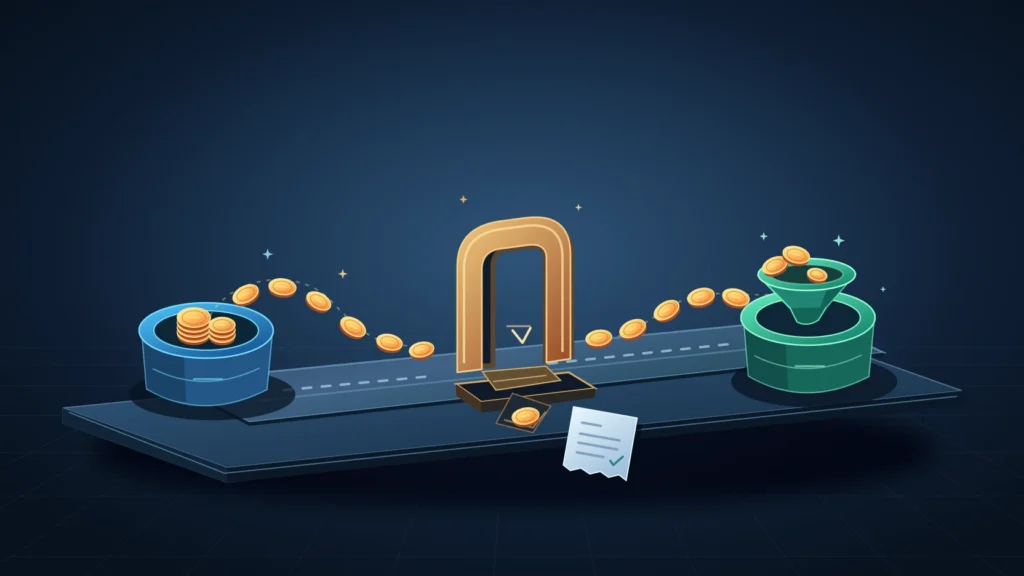
Your app shows an STP of ₹50,000. Why might only ₹49,750 reach the second fund? In this hypothetical example, a 0.5% exit load on the source fund redemption is ₹250. Tax is a separate calculation. Follow the money through one instalment.
The three-point summary
- Every STP instalment involves a source redemption and a destination purchase.
- Exit load and capital gains are different calculations; the entire transfer is not profit.
- Phased entry changes timing exposure. It does not eliminate losses or guarantee a better outcome than a lump sum.
Draw the money trail first
A conventional AMC STP operates between eligible schemes within the same fund house. A platform offering transfers across fund houses may use a different operational arrangement. HDFC Mutual Fund’s STP explanation separates the redemption and purchase legs. Read the confirmations for the exact scheme, plan, option, units, NAV and transaction date rather than relying on the dashboard label.
The destination units receive a fresh allotment date. Their future holding period and applicable exit-load treatment relate to their own purchase history; the age of the source investment does not travel with the money. Where the source contains purchases made on several dates, inspect the lots shown in the capital-gains statement. Do not assume the source’s oldest date applies to every unit.
Follow one ₹50,000 instalment
Suppose 500 source units originally cost ₹98 each and are now redeemed at a NAV of ₹100. The gross redemption value is ₹50,000; the acquisition cost is ₹49,000. The difference is ₹1,000, not ₹50,000. These are invented numbers for explanation, not actual NAVs or a return forecast.
First assume no exit load and ignore other transaction costs. ₹50,000 goes into the destination. At an assumed NAV of ₹25, it buys 2,000 units. If the next instalment executes at a different NAV, it buys a different number of units even though the instructed amount is unchanged.
Now consider a separate scenario with a hypothetical 0.5% exit load on that redemption. The load is ₹250, leaving ₹49,750 before any stamp duty or other applicable deductions. At an illustrative target NAV of ₹25, that would buy 1,990 units before such deductions. The target purchase may use a different date and NAV, depending on funds availability and cut-offs. This is not a statement of any scheme’s load. The actual schedule, allotment date and STP terms control. Also establish whether the service treats the instruction as a gross redemption or a net destination amount.
Keep tax separate from exit load
The capital-gains treatment depends on the source scheme’s tax classification, acquisition dates, holding period, investor status and law applicable to the transaction. Moving from debt into equity is not automatically a tax-free event. Equally, a redemption does not mean tax must always be paid: a loss or other applicable provisions can change the result.
₹1,000 is the simplified gain only in the no-load, no-other-adjustments case. It is not the tax due. For an actual redemption, use the source scheme’s capital-gains statement and the law applicable to that tax year, accounting for any legally allowable costs only once.
Compare the benefit with the trade-off
An STP spreads equity purchases across several dates instead of concentrating them on one day. If markets rise steadily, later instalments may buy at higher prices. If markets keep falling, both earlier and later purchases can lose value. The source fund also remains an investment with its own risks; a debt or liquid fund should not be treated as a guaranteed bank balance.
A twelve-instalment instruction also needs sufficient transferable balance. The arithmetic ₹6 lakh divided by ₹50,000 equals twelve, but returns, losses, charges and operational terms can affect the actual sequence. Holidays, cut-offs and insufficient balances are handled under the service’s terms. Check what happens to a residual balance when the instruction ends.
A practical pre-registration checklist
- Write down the goal and why gradual deployment suits its time horizon.
- Read the source and destination SID, KIM and STP form for eligibility, minimums and cancellation procedures.
- Record source purchase dates and the exit-load schedule; estimate gains or losses on each redemption rather than on the whole balance.
- Reconcile the source units sold, destination units allotted and remaining source units against confirmations.
- Keep tax funding separate from the investment instruction, and retain statements throughout the year.
Three common questions
Does cancelling the STP sell the investments?
Ordinarily, cancellation stops future transfers; it does not itself redeem existing holdings in either scheme. Check the AMC’s confirmation. Selling source or destination units is a separate instruction and decision.
Is a daily STP always better than a monthly one?
No. Greater frequency means more transactions, not a guaranteed return advantage. Compare simplicity, relevant load rules and the intended deployment period rather than selecting the busiest-looking schedule.
Is an STP from a liquid fund risk-free?
No. Read the source scheme’s risk disclosures and operating terms. Avoid making all immediately needed household cash dependent on an investment-transfer arrangement.
Takeaway
Think of an STP as a plan for two holdings and many transaction dates. Ask not only how much moves, but which units are sold, what costs apply and when new units are allotted. This article is educational, not personalised investment or tax advice. Mutual fund investments are subject to market risks.
Related reading: SIP returns: XIRR and absolute return (Hindi) · Browse Finance Blogs
Sources and verification
References reviewed for this draft. Check the terms of the specific scheme and the law for the applicable tax year.
चर्चा / Comments