26 November 2026 · Reading time: about 6 minutes
Already investing in a mutual fund, but another fund house is asking for KYC? From 24 December, some verified details can be reused. The practical question is what has already been checked, not whether KYC goes away.
What changes on 24 December?
Suppose you already invest with one mutual fund house and want to open your first folio with another. You expect the new provider to check who you are. The frustrating part is being asked to enter details that have already been checked against official records. SEBI’s new circular addresses some of that duplication. It does not remove the obligation to complete KYC.
SEBI issued its circular on 25 November 2026. Its provisions generally take effect on 24 December 2026, unless a provision specifies otherwise. Certain details that financial intermediaries commonly collect will be stored at the KYC Registration Agency, or KRA. Another eligible intermediary can obtain information from that record during onboarding. Think of that as reuse of some checked information, not automatic approval to invest.
There is an important distinction between the information used to identify and verify you and the information needed for a particular account or service. The fund house can still require an application and service-specific details. The circular also provides for recording a Central KYC identifier and DIGIPIN where available, and a document’s expiry date where relevant. A KRA is not the same as the central CKYC registry. Having a CKYC identifier does not on its own tell you that every item in your KRA record is validated.
Which details can still be requested?
The covered common details include income band, occupation, politically exposed person status, and certain tax-residency information under FATCA and CRS. An intermediary can obtain the record, while the KRA marks which details it has independently checked. This is the distinction that matters in practice: a detail can be on file without being validated.
Under the updated framework, validation still requires verification of the prescribed details against official sources. For address, one of your current or permanent addresses can be source-verified; verification of the PAN–Aadhaar link is also part of the stated criteria. A validated tag does not follow simply from having a linked PAN and Aadhaar. If the record fetched from the KRA is not validated, the intermediary must seek the additional information that is relevant.
Repeat mobile verification is optional for the intermediary only where the number in the KRA system is both verified and tagged as linked to Aadhaar. A number appearing in the database is not enough. Nor does the circular do away with one-time passwords for signing in, paying or authorising a transaction. Those can be requested for a different purpose.
Intermediaries are also required to act on applicable updates from the KRA and the central registry, and to give clients a way to confirm changes. They can still ask for additional information as part of due diligence. If you have changed your address or mobile number recently, check which details the provider has rather than expecting a new application to resolve old inconsistencies on its own.
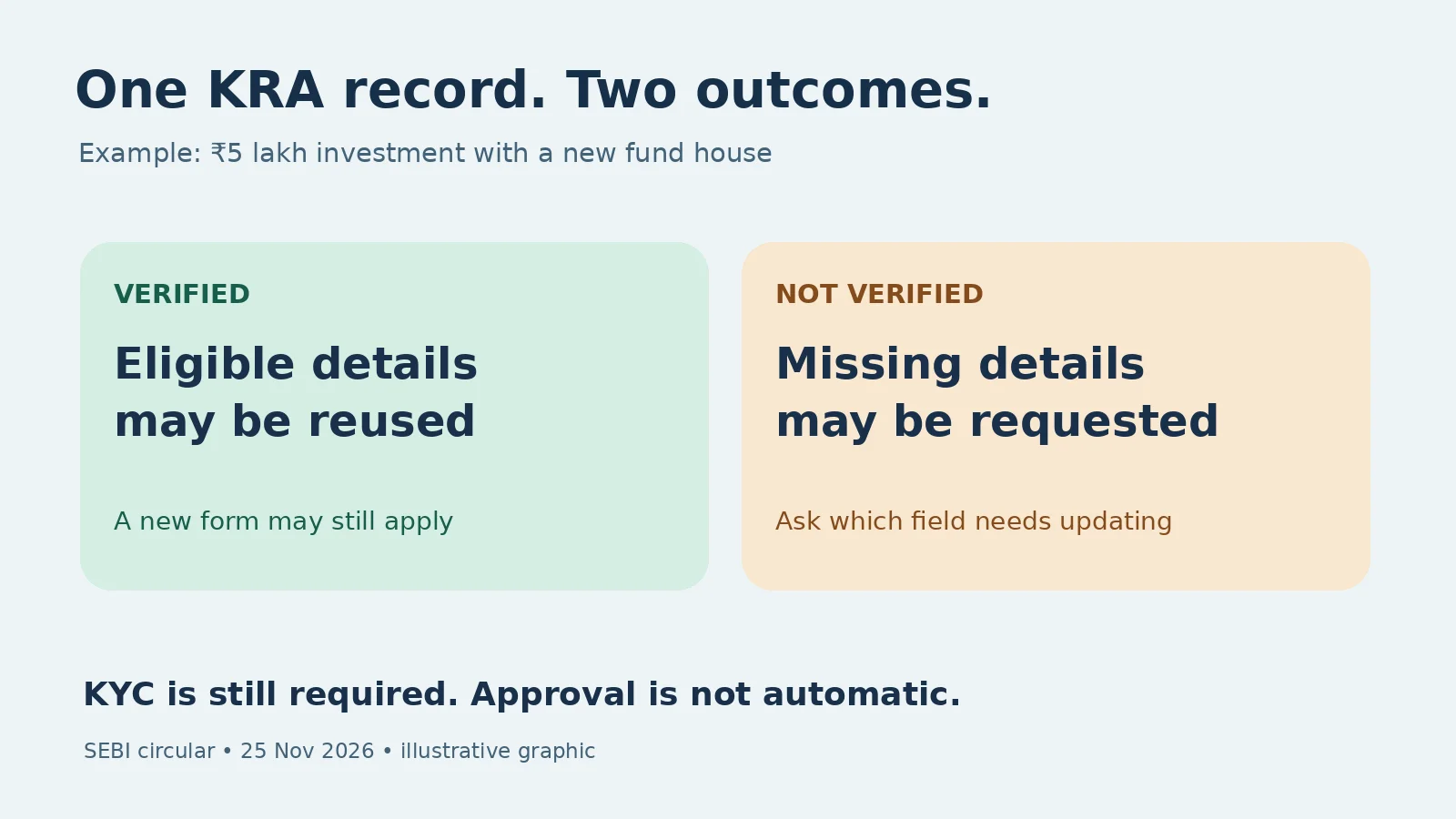
A ₹5 lakh example: same investment, different paperwork
Meera and Ravi each intend to invest ₹5 lakh with a new fund house. Neither has an existing folio there. The amount is deliberately the same, to isolate what makes a difference to the paperwork. ₹5 lakh is not a regulatory threshold and the example does not recommend an investment.
Meera has a validated record. The prescribed details have been source-verified. The new fund house can use eligible details from that record instead of necessarily asking her to supply the same information again. She may still need to complete its folio application and provide service-specific information.
Ravi has an unvalidated detail. The intermediary can ask for the relevant information. Instead of uploading every document again, Ravi can first find out exactly which item is missing or has not been verified, and how the provider wants him to update it.
Neither route changes the fund’s NAV, expenses or investment return. Nor does the circular promise that Meera’s folio will open instantly. If you are investing on a date that matters to you, confirm the account and any documentation requirements before transferring money. A smoother KYC process is useful, but it is separate from the decision to invest.
An empty folio is not the same as an active SIP
SEBI included a separate rule for a client whose balance is zero across folios with the relevant mutual fund for six months. It is not enough that one folio is empty if the same fund house still holds units for that investor under another folio. Once the stated conditions are met, the fund or its registrar and transfer agent, known as the RTA, must notify the KRA within five working days of the six-month period ending. The KRA then stops sending KYC updates to that fund or its RTA within two working days of receiving that notice.
This is about which firms continue receiving future KYC updates. It is not cancellation of the underlying KYC record, and it does not remove units held at another fund house. If you decide to invest again with the same fund house later, check the status and its current application requirements at that time. There is no reason to stop an active SIP, switch a scheme or redeem a holding just because this circular was issued.
Account closures at intermediaries other than mutual funds, and cases where a record was retrieved but no account was opened, have separate rules and timelines. A message about an unused brokerage application is not the same as an update about your mutual fund folio. Read the notice for the relevant provider and product before assuming the same rule applies.
Four checks before you open a folio
- Check the status on an official channel. Use the fund house or its registrar’s usual KYC status service. If prompted for more information, identify the exact missing or unverified field.
- Check changes in your particulars. If you have changed your name, address or mobile number, compare the official document and KYC records. Updated PAN and Aadhaar provide one route for a name change; the circular describes alternatives in specified cases.
- Check old folios separately. Look across the folios held with the same fund house, not a single empty row in an account statement. Do not confuse stopping updates with erasing a KYC record.
- Check unexpected messages independently. Open the official app or site directly rather than sending an OTP or identity document to someone who contacts you unexpectedly.
Overseas investors should not assume that the resident example applies to them unchanged. The circular extends specified provisions to certain individual persons resident outside India from FATF-compliant countries. It also sets different address-proof conditions for eligible OCI cardholders and foreign nationals resident in India. Confirm the procedure that applies to your status.
The bottom line: The change makes it easier to reuse eligible verified information, not to skip KYC. When a fund asks for more paperwork, find out which detail needs attention and handle that first. The circular gives KRAs time to issue implementation procedures, so check the official instructions when you actually apply.
For education only. The example is not investment or legal advice.
Source and rule details
Primary source: SEBI, circular dated 25 November 2026 · Full circular (PDF). Relevant sections: 3.1 to 3.7, 6 and 7.
Cover: AI-generated editorial illustration.
चर्चा / Comments