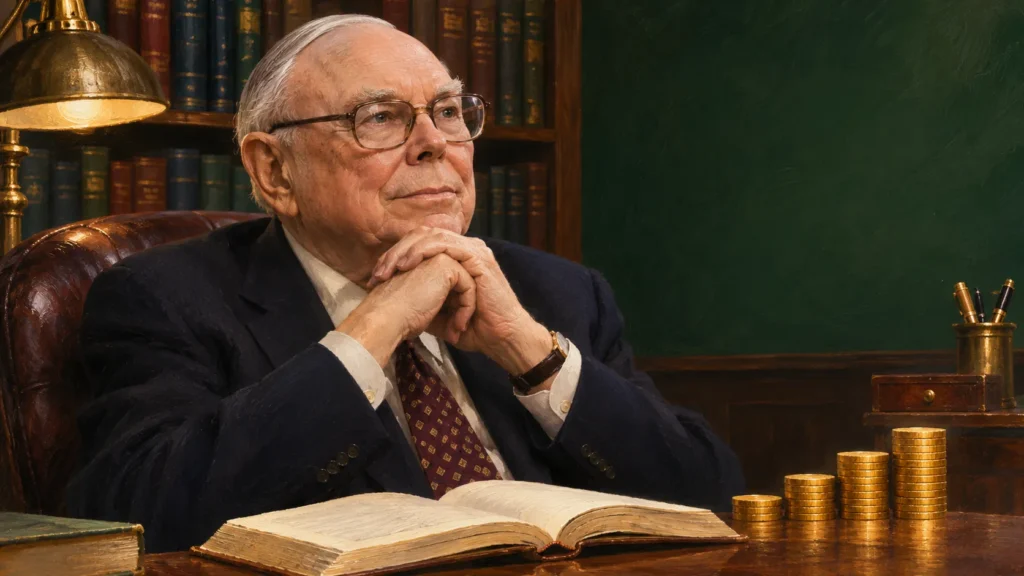
About 4 minutes · Featured image: AI-generated editorial illustration.
Why do some people make money but struggle to keep it? The Charlie Munger lens is useful because it starts with the decisions that can undo years of progress. Buffett called him the architect of Berkshire Hathaway. Here are five reasons wealth can stall, with examples in rupees and original Berkshire sources.
1. Leaving nothing to compound
The first problem is easy to miss: income is not the same as investable surplus. When every raise is matched by more spending, there is little left to grow. Some households have no room to save after essentials; a budget cannot fix insufficient income. Where there is room, decide what can be set aside before discretionary spending absorbs it.
A monthly surplus of ₹10,000 can add up to ₹1.20 lakh in a year. That figure is entirely contributions, with no investment return assumed.
2. Trying to get rich quickly
In Berkshire’s 2023 annual report, Warren Buffett recalls how Munger pushed him away from hunting only for bargains and toward buying better businesses at reasonable prices. A promise to double money quickly focuses attention on the payout, not on what you pay or how much you stand to lose.
A sharper question: if the investment stopped making headlines for three years, what reason would you still have to own it?
3. Borrowing to chase returns
In Berkshire’s 2017 shareholder letter, Buffett acknowledged that their caution about leverage had sometimes reduced returns. He and Munger still preferred to limit the risk. For an individual investor, the point is straightforward: the asset can fall, but the loan payment still comes due.
Suppose you invest ₹10 lakh using ₹5 lakh of your own and ₹5 lakh borrowed. A 40% fall leaves the investment worth ₹6 lakh. If the entire ₹5 lakh principal is still owed and you repay it then, only ₹1 lakh remains, before interest and fees. The investment fell 40%; your own stake fell 80%.
4. Copying other people’s winners
A friend’s winning fund tells you almost nothing without the purchase date, the full holding period and the risk they took. Changing your plan on the strength of a screenshot means letting someone else’s result set your timetable.
In Berkshire’s Owner’s Manual, Buffett and Munger ask shareholders to think like long-term part-owners rather than traders in a fluctuating piece of paper. This does not mean holding every investment forever. It means knowing what changed before you decide to sell or switch.
5. Buying what you do not understand
Berkshire’s 1996 letter emphasises knowing the limits of what you can evaluate. Start with two sentences: where does my money go, and what could cause a loss? If your only answer is that returns have looked good lately, there is more to learn.
You do not have to understand every product. An investment can rise after you pass on it without making your original decision wrong.
If it fell 40% tomorrow, what would I have to change in my life? The answer can tell you more about the size of the position than another return chart. These habits cannot guarantee wealth; income, responsibilities and bad luck matter too.
Ankit Khare · Educational, hypothetical examples; no return is guaranteed. Munger’s ideas are paraphrased from Berkshire’s records; the examples are the author’s.
Sources
- Berkshire Hathaway 2023 Annual Report · Charlie Munger tribute
- Berkshire Hathaway 2017 Shareholder Letter · borrowing risk
- Berkshire Hathaway 1996 Shareholder Letter · circle of competence
- Berkshire Hathaway Owner’s Manual · long-term ownership

चर्चा / Comments