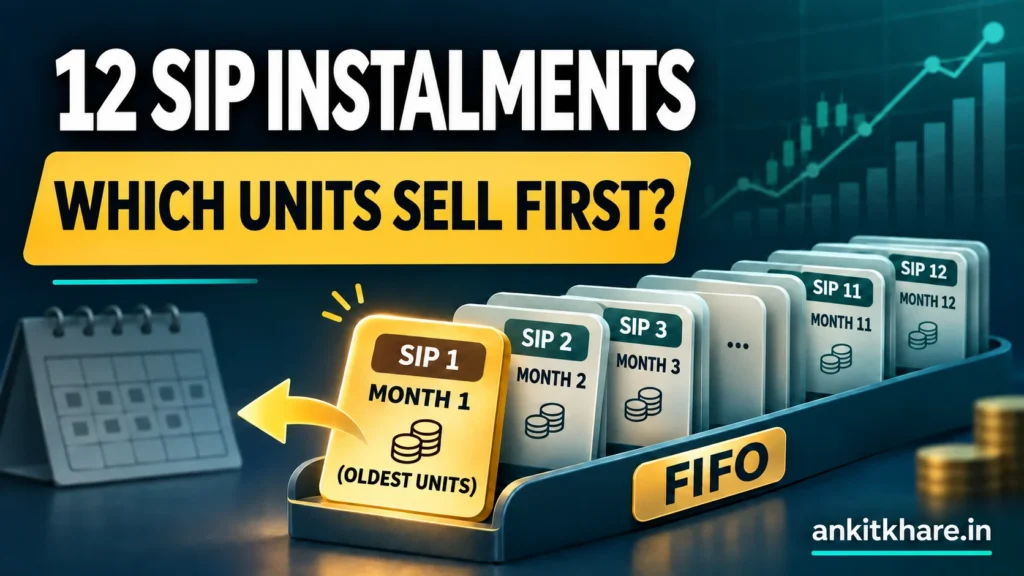
Twelve SIP payments. One investment balance. You need half the money. Does the fund sell half of every instalment, or simply the first six? Neither is necessarily correct.
Your app combines the value into one number, but the units behind it have different purchase dates and costs. Those details matter when you withdraw. A single redemption can contain both long-term and short-term gains, and the last purchase used in that redemption may be sold only partly. Understanding this is more useful than remembering how long your SIP mandate has been running.
FIFO: the oldest available units leave first
FIFO means First In, First Out. In a normal mutual-fund redemption, the earliest purchased available units are treated as redeemed first. Once that purchase lot is exhausted, the calculation moves to the next lot. The JM Financial Mutual Fund Statement of Additional Information, hosted by AMFI describes this ordering for units bought on different dates.
Think of the units as a queue, not twelve separate bank deposits from which an equal amount must be taken. The queue applies to the relevant holding being redeemed. Do not combine all your funds, plans, options and folios into one imaginary queue. If an older lump-sum purchase exists in that holding, starting your calculation at the first SIP payment may be wrong. Previous withdrawals also matter because some older units may already have left.
A ₹10,000 SIP: twelve purchases, two different NAVs
Our illustration uses an ordinary unlocked equity-oriented growth fund in one folio, plan and option, with no earlier investment, redemption, switch or bonus units. Every instalment is ₹10,000. For simple arithmetic, the first six purchases have a NAV of ₹100 and the next six a NAV of ₹125. These are invented educational figures, not actual fund performance or historical NAVs. Stamp duty, transaction charges, exit load, STT and tax are excluded from the unit arithmetic.
At ₹100, ₹10,000 buys 100 units. At ₹125, the same amount buys only 80 units. This is why equal contributions do not mean equal units. The following dates are assumed allotment dates, not merely dates on which a bank debit appeared.
| Lot | Allotment date | Amount | NAV | Units bought | Units sold |
|---|---|---|---|---|---|
| 1 | 10 Nov 2025 | ₹10,000 | ₹100 | 100 | 100 |
| 2 | 10 Dec 2025 | ₹10,000 | ₹100 | 100 | 100 |
| 3 | 12 Jan 2026 | ₹10,000 | ₹100 | 100 | 100 |
| 4 | 10 Feb 2026 | ₹10,000 | ₹100 | 100 | 100 |
| 5 | 10 Mar 2026 | ₹10,000 | ₹100 | 100 | 100 |
| 6 | 10 Apr 2026 | ₹10,000 | ₹100 | 100 | 40 |
| 7 | 11 May 2026 | ₹10,000 | ₹125 | 80 | 0 |
| 8 | 10 Jun 2026 | ₹10,000 | ₹125 | 80 | 0 |
| 9 | 10 Jul 2026 | ₹10,000 | ₹125 | 80 | 0 |
| 10 | 10 Aug 2026 | ₹10,000 | ₹125 | 80 | 0 |
| 11 | 10 Sep 2026 | ₹10,000 | ₹125 | 80 | 0 |
| 12 | 12 Oct 2026 | ₹10,000 | ₹125 | 80 | 0 |
| Total | 12 purchases | ₹1,20,000 | — | 1,080 | 540 |
Assume the applicable redemption NAV on 18 November 2026 is ₹150. The holding is worth 1,080 × ₹150 = ₹1,62,000. Half its current value is ₹81,000. Ignoring the excluded costs, that requires 540 units: ₹81,000 ÷ ₹150.
Afterward, 60 units from April and 480 units from the later six purchases remain. Together they are 540 units, worth ₹81,000 at the assumed NAV. Their original purchase dates do not reset simply because another part of the holding was redeemed. A later sale would continue with the remaining oldest units.
“Half the money” needs a clear definition
Half the current market value is ₹81,000 here. Half the amount originally contributed is only ₹60,000. At a NAV of ₹150, ₹60,000 would require 400 units, which would exhaust the first four lots in this example. These are different withdrawal instructions. Always clarify whether you mean a fixed rupee amount, half the current value, or half the units.
Likewise, asking to withdraw “only my profit” does not create a special profit bucket. The withdrawal still sells units, each containing an acquisition cost and a gain or loss. The displayed overall profit is not automatically the taxable gain in the amount you withdraw. The NAV applied at processing may also differ from the number you saw when deciding, and deductions can make net cash received different from a simple screen-value calculation.
Each purchase has its own clock
The Income Tax Department’s capital-gains guidance distinguishes equity-oriented mutual-fund units held for more than twelve months from shorter holdings. The relevant clock belongs to the units sold, not the SIP registration date. Twelve monthly payments also span roughly eleven months between the first and twelfth payment, not twelve completed months for every purchase.
| Units sold from | Holding on 18 Nov 2026 | Illustrative classification |
|---|---|---|
| 10 Nov 2025 | 12 months, 8 days | Long-term |
| 10 Dec 2025 | 11 months, 8 days | Short-term |
| 12 Jan 2026 | 10 months, 6 days | Short-term |
| 10 Feb 2026 | 9 months, 8 days | Short-term |
| 10 Mar 2026 | 8 months, 8 days | Short-term |
| 10 Apr 2026 | 7 months, 8 days | Short-term |
Only the first 100 units are long-term in this example. The other 440 sold units are short-term. The remaining May-to-October purchases have not been sold at all, so this redemption does not realise gains on them. Your registrar’s capital-gains statement is the appropriate place to reconcile the final lot-level result.
₹81,000 withdrawn does not mean ₹81,000 taxable gain
Every sold unit in our example cost ₹100. The cost of 540 units is ₹54,000 and gross proceeds are ₹81,000, giving an illustrative realised gain of ₹27,000. Of this, the first 100 units generate ₹5,000 of long-term gain: ₹15,000 proceeds minus ₹10,000 cost. The remaining 440 units generate ₹22,000 of short-term gain: ₹66,000 minus ₹44,000.
For qualifying equity-oriented fund transactions subject to the applicable STT conditions, the Income Tax Department’s capital-gains FAQs explain the 20% short-term rate and 12.5% long-term rate above the aggregate ₹1.25 lakh annual threshold for covered gains. Applicable surcharge and cess are additional. The threshold is not a fresh allowance for every fund or withdrawal.
Thus 20% of the example’s ₹22,000 short-term gain is ₹4,400 before surcharge and cess. The ₹5,000 long-term component must be considered with your other covered gains and available annual threshold. This is not a final tax bill: losses, exemptions, taxpayer circumstances and other rules can change the outcome. Do not apply this equity illustration indiscriminately to debt, gold, international or other non-equity funds; their classification and tax treatment can differ.
Exit load and lock-in are separate checks
A tax holding-period threshold is not an exit-load rule. A scheme can have its own load period, exemptions and conditions, so check the applicable Scheme Information Document and transaction statement. Because different instalments have different dates, a redemption can involve older units outside a load period and newer units still within it. Do not assume every mutual fund charges the same percentage or uses the same period.
ELSS is another important exception to our unlocked-fund assumption. Its units have a three-year lock-in from their respective allotments, illustrated in the NJ ELSS Tax Saver Scheme Information Document on AMFI. Completing twelve ELSS SIP payments does not unlock the whole investment. FIFO does not override a lock-in, lien or other redemption restriction.
Five things to do before redeeming
- Identify the holding: verify scheme, plan, option and folio, including earlier lump sums, switches and previous sales.
- Download the transaction statement: use actual allotted units, dates and costs, not an estimated amount divided by today’s NAV.
- Define the withdrawal: distinguish current-value percentage, unit quantity and fixed cash requirement. Allow for charges and NAV changes.
- Walk through the queue: subtract the oldest available units first and stop at the required quantity, including a partial final lot if necessary.
- Check each sold lot: reconcile holding period, gain or loss, exit load, restrictions and annual tax position with the official capital-gains report.
AMFI’s NAV-applicability guidance explains why purchase NAV depends on receipt and availability of funds and the relevant cut-off. A chosen SIP date or bank debit alone is not enough to reconstruct allotment details. Ask your AMC or registrar for records when needed; never post PAN, folio or account details in public comments.
Quick answers
Can I choose the newest instalment first? Do not assume arbitrary lot selection in a standard FIFO redemption. Check provider rules for the particular holding rather than treating all accounts as interchangeable.
Does stopping the SIP sell existing units? No. Cancelling future purchases and redeeming existing units are separate actions. If the mandate continues after a partial redemption, a later payment can add a new purchase lot.
Should I delay a withdrawal just to save tax? Not automatically. Cash needs, goals, market risk and costs all matter. Waiting may change both the tax classification and the investment’s market value. This article explains the mechanism, not a personal sell-or-hold recommendation.
By Ankit Khare. Sources checked 18 November 2026. All numerical examples are hypothetical, not a fund-return claim or forecast. Educational information only, not personalised investment or tax advice. Consult a qualified professional for your circumstances. Mutual-fund investments are subject to market risks; read all related documents.


चर्चा / Comments