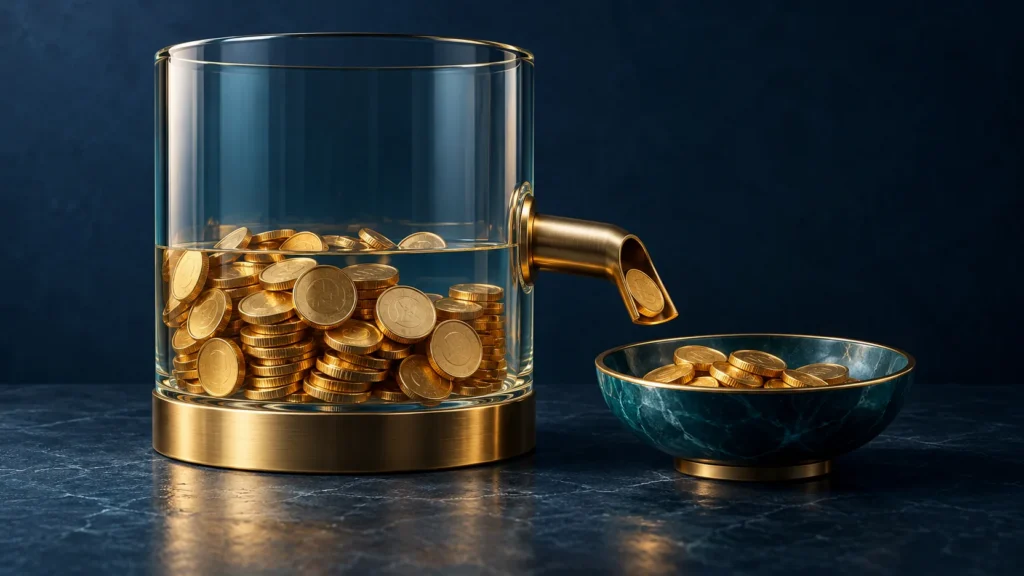
AI द्वारा बनाया गया चित्र
By Ankit Khare · Estimated reading time: about 3 minutes
At a glance
An IDCW payment increases your bank balance, but the fund’s NAV is adjusted too. To understand what you have earned, look at the payout, the value of the investment that remains and the money you invested.
A message arrives on your phone: you have received ₹10,000 from a mutual fund. That feels good. But is the entire amount a profit? The message alone cannot answer that. An IDCW payment needs to be considered alongside the remaining value of your investment.
The name IDCW contains an important clue
IDCW stands for Income Distribution cum Capital Withdrawal. A distribution may include part of an investor’s capital. A scheme document hosted by AMFI explicitly describes this possibility. That does not mean every payout consists entirely of principal, either. Do not decide how much is income and how much is capital merely by looking at the payout.
The amount and regularity of IDCW are not assured. The scheme’s rules, distributable surplus and the trustees’ decisions matter. Several months of past payouts do not guarantee a payment next month.
How can you receive ₹10,000 without your total money increasing?
Suppose you hold 10,000 units and the NAV immediately before the record-date IDCW adjustment is ₹12. Your investment is worth ₹1,20,000. The scheme declares IDCW of ₹1 per unit, giving you a gross payout of ₹10,000.
Considering only the effect of this distribution, the NAV becomes ₹11 and the investment value becomes ₹1,10,000. Add the ₹10,000 gross IDCW receivable: the total is ₹1,20,000. The value is now split into two components; the payout has not created new wealth by itself. The official PPFAS factsheet also explains that NAV falls to reflect the IDCW payout and any applicable statutory levy.
This example uses the IDCW payout option: the distribution leaves the 10,000 units unchanged while NAV adjusts. The actual bank credit may occur later. This is a simplified, hypothetical example. It excludes tax/TDS, levies, other cash flows and market movements on the same day. Actual NAV will also reflect the market, so do not attribute an entire daily decline to IDCW alone.
Where does the profit show up, then?
If you originally invested ₹1 lakh in these units and neither added nor withdrew anything in between, the calculation in this example is: ₹1,10,000 remaining value + ₹10,000 payout − ₹1,00,000 cost = ₹20,000 total gain, before tax and other costs. Part of that gain is still in the investment. The ₹10,000 payout alone does not tell you your total gain.
Under the same simplifying assumptions and with no other intervening cash flows, if an investment’s remaining value is ₹85,000 and its payout is ₹10,000, against an original cost of ₹1 lakh, the total is ₹95,000. Despite receiving money, you have a total loss of ₹5,000. In both examples, receiving a payout and making a profit are separate questions.
Check four things in your statement
- How much did you invest in total, and when?
- How much gross IDCW was declared, and how much actually reached your bank?
- How many units remain, and what is their current market value?
- Were there any redemptions, reinvestments or additional investments in between?
Adding several years of payouts and dividing them by the investment does not give an annual CAGR. Cash flows on different dates must be included in a return calculation with their correct dates. Under the reinvestment option, the distribution buys additional units; do not double-count it as both a cash payout and an increase in the value of your units.
What should you rely on for household expenses?
When choosing IDCW, do not look only at previous payouts. Consider NAV, total return, risk and your cash needs together. Keep records of gross and net amounts for tax purposes and check the rules applicable at the time. This article does not specify a tax rate or a tax conclusion that applies to every investor.
The useful questions are: “How much money came in?” and “What is the total remaining value of my investment?” You need both answers to see the full picture.
This material is for information and education, not personalised investment advice. The examples are hypothetical. Mutual funds involve risk; returns, payouts and preservation of capital are not guaranteed. Understand your goals, risks, costs and applicable rules before making a decision.
Sources and calculations
- AMFI-hosted scheme disclosure: capital distribution and distributable surplus
- PPFAS September 2025 factsheet: NAV adjustment on IDCW; historical document used only for the mechanism
- Calculations: hypothetical examples based on the inputs and formulas stated in this article.
Sources rechecked: 30 October 2026. The AMFI-hosted HSBC scheme document dated 28 November 2025 (pages 35–36) and PPFAS September 2025 factsheet (page 9) were checked for IDCW mechanics only, not current performance or payouts. Examples are hypothetical.


Discussion / Comments
All Comments
No published comments yet.